Complexity of the Bond
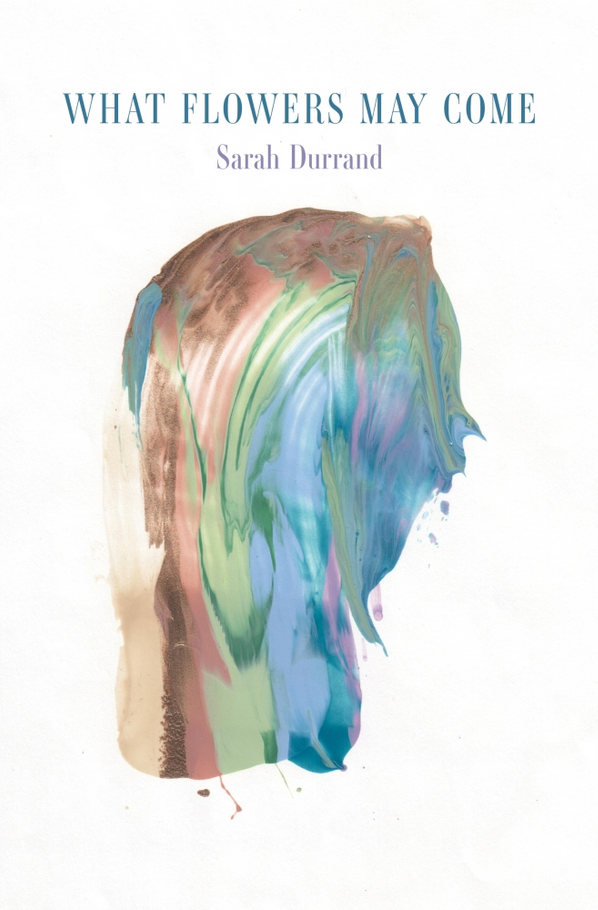
What flowers may come
Sarah Durrand
Finishing Line Press, 2026
Finding our place in this world—that is, figuring out where we want to be, who we want to be with, and simply who we are—is a daunting, forever-incomplete task. To live in this world is to constantly discover more of ourselves, and since we’re only human, there will always be a friction between what we have and what we yearn for. Whether that means recapturing the spark of old bonds or starting over somewhere completely new, Sarah Durrand’s What Flowers May Come (Finishing Line Press, 2026) sensitively catalogues a wide variety of moments in which the speaker seeks to understand how they fit into the framework of their own life, and what it means to want beyond that.
Notable from this summation is the attention these poems give to the complexity of the bond—bond meaning our relationship with others, bond meaning our connection to home, even bond meaning our ties to the person we are, perhaps were. Yet, for as attentive as the collection is to showcasing all the connective tissue surrounding its speaker, so too is it attentive to the natural world they inhabit. The treatment of the interior and exterior are never exclusive to one another, either. Durrand’s’ depiction of the human connection is always transposed intentionally over facets of the living environment, facets that at times better articulate concepts or struggles than if the poem went without drawing parallels at all.
It feels intentional, then, when considering the broader arrangement of the collection, that one of the earliest poems we read is “A Persimmon For You, For Me,” in which time and its many passages are signified by a laundry list of real-world objects. Cereal, kitchenware, and of course persimmons, all sensitively reflect how the things we value enough to carry forward with us are themselves subject to change—be that a change on their terms, or a change in ourselves and the way we view them. Describing how these symbols portray lives and inevitable endings often without explaining themselves, the poet writes, “I create space in the backyard / to drink strong tea and / enjoy the feeling of finishing / things, not things finishing,” yearning for a kind of connectivity unabated by the fear of impending change.
Another early entry in the collection that speaks to a similar sentiment is “Raindrops After Rain,” in which the speaker describes the dropping of a lemon from a tree and ponders at what point it may have experienced its “death”:
When did it die?
When its stem started loosening,
when the last fiber snapped?
When it bruised on impact,
or when it stopped rolling?
When it started to rot in vain?
When I noticed it and couldn’t eat it,
or when I threw it away?
What’s interesting about What Flowers May Come is that its many works continually play with the transparency of its metaphors without permanently settling for the obvious or obfuscated. While in the above-mentioned poems, the questions posed and the real-world avatars of those questions are clear, sharp, strong for their acuity, other poems ask the reader for more. Like in “Red Admiral,” which portrays its lessons learned through quickly-flitting, impressionistic images: “I’ve learned you must ask a butterfly to beat the clouds / away and nod to the crows when you see them, / watch the swallows dive…” and so on, alluding to the strengths of communing with the world and all its vitality, without the poem needing to show its full hand. That said, I especially love the line that begins “Red Admiral”’s final stanza, coming to us as if we’ve reached a clearing in the wood: “It’s rare to know exactly where you should be.” The consistent play between clarity and abstraction should be any strong poet’s bread and butter, and Durrand clearly trusts the readers of What Flowers May Come to feel through the collection’s grander ideas on their own terms, while still making a powerful effort to reveal something raw and vulnerable on the page.
And these poems are vulnerable, though not just by way of revealing the speaker’s interiority. Vacillating from poem to poem—never committing itself to a smoothly-evolving portrayal—is the speaker’s complex bond with a certain lover or companion. Immediately following “Raindrop After Rain”’s retrospective on endings comes “Geraniums,” in which the speaker is in the throes of passion on top of a mountain, brief and unrestrained in its crisp, bright, sensory relishing of the person in front of them. Yet following that just two poems later is “Butterfly Pea Flower Tea,” in which the speaker regretfully explores what they could’ve done differently for their bygone companion, “Picturing all the ways you must have looked / while I was looking somewhere else.” These quick back-and-forths are striking, pulling the reader with such strong force to different points in time to elicit the same sharp, raw stings, the same highs, and the same low points the speaker themselves feels.
To sum up, Sarah Durrand’s What Flowers May Come explores a lot of subjects intimately and powerfully, notable among them being the negotiation of who we are and who we want to be in a world of constantly-fluctuating permutations. But one thing the collection never claims to do is know all the answers to its own questions. Yet still, daring to learn more, to want more, to trip and make mistakes and agonize over those falls is the heart of this book, and these feats are all rendered with immense empathy and honesty. We are just as much subject to change as the living, breathing world we are tasked with joining, and there’s a humility to accepting that we won’t always know what we want to know, or change what we want to change, even inside ourselves. This road to acceptance is the collection’s greatest strength, and as Durrand herself writes in “Galaxial,” the collection’s final poem:
I wondered my way to a breakthrough and
learned I’m allowed to be a mystery myself.
To me, there are few ways to put such a powerful truth more concisely.

This review has been edited for style.
Basil James is portrait artist, ex-English teacher, and poetry editor for Chaotic Merge Magazine. They currently reside in Olympia, Washington. Basil’s work is featured in ellipsis… literature and art, OxMag, Watershed Review, storySouth, and will soon be published in INKWELL. Basil also has a couple English degrees hidden away somewhere in storage. Follow them on Instagram @gaybarrymore.